




ASSESSMENT AND TALENT INTELLIGENCE
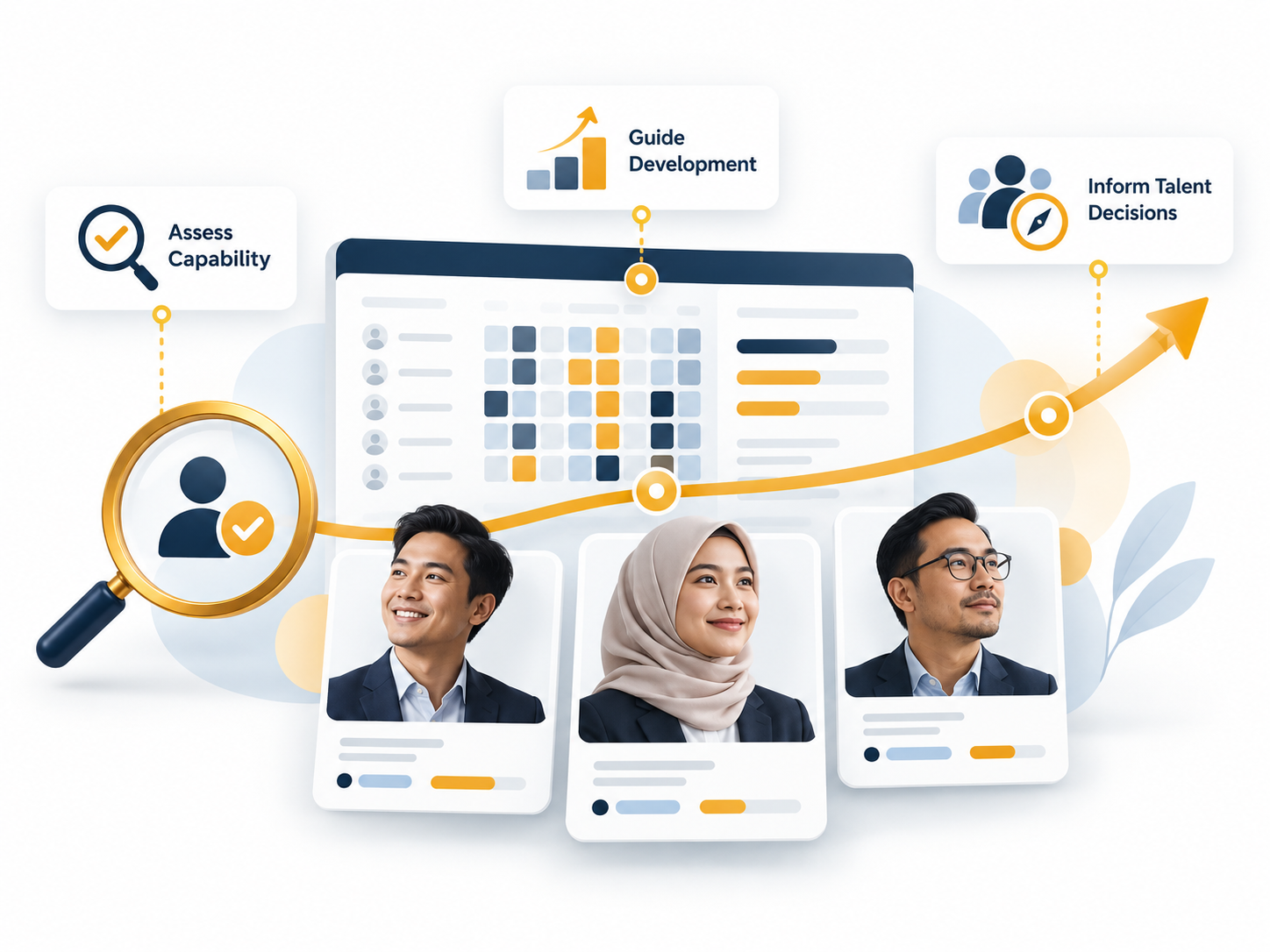
From opinion to evidence in every talent decision.
Talent reviews, training needs analysis and training evaluation are sound practices. Most run on opinion, attendance and satisfaction scores. We help HR and L&D teams put skills evidence behind each one — so the decisions stand up when leadership asks “how do you know?”
See how it changes your practices
The practices are right. The evidence is thin
Every year, HR and L&D teams sit through talent review meetings, collect training requests and send out post-course surveys. The work is real. But when a leader asks who is ready to step up, which gaps matter most, or whether the training changed anything on the job, the answer is often a judgement call.
That matters more as skills move faster. In the World Economic Forum’s Future of Jobs Report 2025, 63% of employers named skill gaps as the biggest barrier to transforming their business between 2025 and 2030. The same report expects 39% of workers’ core skills to change by 2030.
Skill intelligence closes that evidence gap. It gives each practice a common language — the skills a role needs, at what level — and a measured view of where your people stand today.
63%
of employers say skill gaps are the biggest barrier to transformation (2025–2030)
39%
of workers’ core skills expected to change by 2030
38%
of organisations evaluate training at Kirkpatrick Level 4 (business results)
Source: ATD, 2019 evaluation study
Talent review: From “I think she’s ready” to “here’s the gap to the next role”
The 9-box plots performance against potential. Performance usually comes from the appraisal. Potential usually comes from a manager’s judgement, debated in a calibration meeting. That second axis is where opinion does most of the work.
Research shows why it matters. A study of 29,809 management-track employees at a large North American retailer found women received lower potential ratings than men despite higher performance ratings — and those potential ratings explained up to half of the gender gap in promotions.
| Today | With skill intelligence |
|---|---|
| Potential is a manager’s view | Readiness is measured against the skills profile of the target role |
| Successors come from the names leaders already know | Assessed skills surface people outside the usual shortlist |
| Calibration debates whose opinion wins | Calibration tests opinions against shared evidence |
| “Ready now / 1–2 years” is a label | Readiness is a visible gap you can plan development against |
Skills data does not replace leadership judgement in a talent review. It gives that judgement something to test itself against.
TNA: From a course wish-list to the gaps that matter
Many TNAs start with a form: “What training does your team need this year?” The answers become a training calendar. It is fast, familiar and mostly opinion — and it assumes training is the answer before anyone has looked at the gap.
TNA is not going away. The method is changing. Instead of asking people what courses they want, we define the skills each role needs, assess where people stand, and let the size and business importance of each gap decide the plan.
| Today | With skill intelligence |
|---|---|
| Managers nominate courses | Gaps are measured against role skill profiles |
| One annual cycle | Reassess as roles and priorities change |
| Every request looks equally urgent | Gaps ranked by size and business priority |
| Training is the default answer | The gap decides: train, coach, redeploy, redesign the role or hire |
| Group plans only | Individual development plans and group plans from the same data |
Skills assessment shows where the gap is. A good needs analysis still decides why it exists and what will close it. We do both.
Training evaluation: from “they liked it” to “their skills moved”
Most organisations measure the first two Kirkpatrick levels — reaction and learning. Far fewer reach behaviour on the job or business results. In ATD’s survey of 779 talent development professionals, about eight in ten measured Levels 1 and 2, 54% measured Level 3 and 38% measured Level 4. The top barrier, cited by 41%, was isolating the training’s effect on results.
Skill intelligence gives you a baseline before the programme and a re-measure after it, on the skills the role actually needs. That turns Level 2 and Level 3 from a quiz score and a survey into evidence of capability change.
| Kirkpatrick level | Typical evidence today | With skill intelligence |
|---|---|---|
| 1 — Reaction | Satisfaction survey | Unchanged — still useful as an early warning |
| 2 — Learning | End-of-course quiz | Pre- and post-assessment against role proficiency levels |
| 3 — Behaviour | Manager follow-up survey, if any | Reassessment of the same skills weeks later, with manager validation |
| 4 — Results | Rarely measured | Skill movement linked to role readiness and the business measures you choose |
Skills data will not prove business results on its own. It gives you the missing link between “they attended” and “the business changed”.
We start with the decision, not the tool
Every engagement begins with the talent decision you need to make. The platform comes later, and only where it helps.
Start with the decision.
Succession for critical roles, next year's development budget, proving a programme worked — we agree what decision the evidence must support.
Define roles and skills.
We build on your existing competency framework, or a recognised public framework, and set the proficiency levels each role needs.
Assess.
Self, manager and structured assessments give a balanced view of current skills.
Analyse gaps and readiness.
Individual, team and organisation views of where the gaps are and which matter most.
Act.
Development plans, learning programmes, coaching, mobility or succession moves — whatever the gap calls for.
Reassess and report.
Measure again, show what moved, and feed the next cycle. The loop returns to step 3.
Return to Step 3: Assess
Where We Come In
eLearningMinds already designs, builds and delivers learning — content, platforms and training. Skill intelligence connects that work to the gaps it is meant to close, so assessment and development sit in one loop instead of two.
Proven platforms, chosen for the job
We work with specialist skills platforms and pick the one that fits your decision, your framework and your scale.

Competency frameworks, role profiling and skills assessment in one place. Best when you need a consistent skills language across roles and a clear line from gap to development priority.
AI-driven skills profiling and assessment across the workforce. Best when you need a fast, organisation-wide view of capability to support hiring, development, mobility and workforce planning.
Planning a talent review, a TNA cycle or a programme evaluation?
Tell us which decision is coming up. We will show you what evidence you already have, what is missing, and how skill intelligence can fill the gap.